China
Country travel logs
Thailand Cambodia China Hong Kong TibetChina

Hong Kong
Hong Kong was an interesting jumping off point into China. Due to the small landmass of Hong Kong island, every building there is a high rise. Almost all of the buildings look like either blocks of flats or offices. When you actually enter them, you discover a whole new world in each. Looking for a travel agent, we stumbled into one of the buildings, being assured that, yes, there were definitely several travel agents on the 8th floor.
Dubiously, we got in the lift, and ascended and when the doors opened, rather than seeing a number of flats, we were presented with a number of travel agents. This was also the case when looking for news agents, restuarants, bars, Internet cafes and so forth.
Although some places were labelled in the lobby, for some it was a case of roulette - hit a button, and see what's on the floor. Our hostel, for example, was on the 1st, 2nd, and 8th floor of a tower block, surrounded by 'normal' residents appartments.
On our sencond day, we asked the owner of the guest house where we could get visas for entry into the Chineese mainland. He quoted us around 10 pounds more each than the Lonely Planet guidebook we had, and attempting to save a little cash, we headed over to the consulate to apply ourselves. Unfortunately, as we were soon to discover, China has bumped up the price of visas for British citizens.
Unfortunately we were also granted a double entry visa for entry twice into China for 30 days each, rather than 1 entry of 60 days. The clerk steadfastly refused to admin that any other visa for a longer period was possible, despite the fact that we had an expired single entry visa for 60 days about 3 pages earlier in our passports due to an earlier aborted attempt to visit during the SARS outbreak. Unfortunately, by the time we received the bill, it was too late to change our minds and go back to the hostel and ask them to arrange a visa for us.
The food was interesting too. On arrival, we decided we'd try out some local cuisine. We wandered about aimlessly for a while before stumbing across a very popular looking restaurant. We sat down, and a menu was duly dropped in front of us. We began to flick through it's pages, and were confronted with several interesting options, ranging from pigs stomach stuffed with duck tongue to tripe soup.
We settled on something vaguely westernised and were surprised how good it tasted. We later learned that it's far more sensible to simply check out what looks good on other tables and ask for that.
Shanghai
After leaving Hong Kong, we headed up to Shanghai. It was our first encounter with Chineese airlines. Despite the plane being delayed for an hour or so, we had none of the nightmare scenarios we'd heard other westerners outlining in the bars in Hong Kong, and we arrived safely.
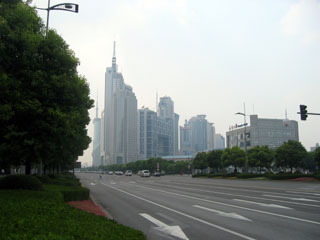
Shanghai was our first taste of real China, and nothing like I was expecting. Having seen video footage of Russia, I expected that China would be similar, mainly grey, concrete tower blocks. I couldn't have been further from the truth. Shanghai is a super-modern city. None of the buildings seemed over 10 years old, and whilst here, we heard the statistic that 9% of the world's crane population is here. Looking at the skyline that is a believable statistic. Shanghai is much like Hong Kong, without the geographic constraints of the Island.
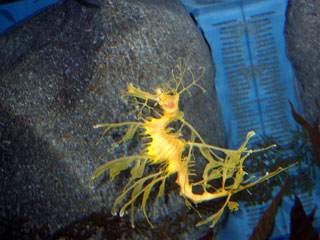
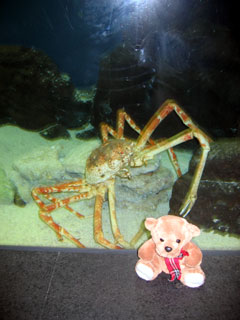
Whilst in Shanghai, we explored Shanghai aquarium. There were some really strange animals being exhibited there, including a sea dragon, and the biggest crab I've ever seen - a giant spider crab. They also had a penguin enclosure.
We also ascended the Pearl Tower, apparently the 3rd tallest building in the world. The views of the surrounding city were amazing. Rather than queueing for the expess elevator to the bottom of the tower, we descended the various pearls one by one. The elevator from the last pearl to the ground was a vertigo inducing glass section, allowing us to see in all directions as we descended about 90 meters. We descended underneath the ground to exit the tower, giving, for an instant the impression that we weren't going stop, and were going to crash.
Finally, we took the Bund tourist tunnel over to the Bund on the west coast of the Huangou Jiang river through Shanghai. It was pretty amazing in a pyschadelic kind of way! The Bund has the oldest buildings in Shanghai, remnants of the colonial port status.
Leaving Shanghai, our encounter with Chineese airlines was not so smooth. For some reason we were diverted to Tianjian (about 100 kms away). No one seemed to know whether the plane would terminate here, or take off again and head towards Shanghai. It didn't help that we spoke no Chineese. The passengers all initially seemed almost bored, resigned to the fact that this was a way of life.
People began milling around the aisles and queuing up to get off. Still no one seemed sure if we would get off here or the plane would carry on. Then the plane door opened, but the air stewardesses placed a barrier in front of it so no one could disembark.
A few minutes later some people began to disembark. Other people were still milling around or still sitting in their seats. All of a sudden the door shut and the plane began taxiing down the runway again and we took off. It was most strange.
Beijing
When we arrived in Beijing, it was slightly cooler than Shanghai and really overcast. We stayed in a youth hostel built into the side of The Worker's Stadium. The smog was so dense that for the first few days, the Sun appeared as faint glow in the sky, and it was impossible to see more than around 10 metres in any direction.
We sampled some of the local chinese restaruants, where the food is nothing like the food in the UK. For a main meal, tea and a beer it cost just over 1 pound. The food was great. We also sampled the famous Peking Duck, which was also different from the more westernised variants available back in the UK. Rather than being fried and more crispy, the duck we had seemed more succulent, and was sliced rather than shredded. The sauce was different as well. Katie prefered it here whereas I prefered the more international one. For 88 yuan (about 6 pounds), for a whole duck, it's well worth it as 1 duck could feed 2 hungry people.
We stayed in Beijing for a couple of weeks (unexpectedly) because everytime I ate Chinese food I was really sick the next day. We came to the conclusion that is must be the peanut oil which is used to fry the food. The first time we went out to eat, 5 of us that ate the same food and only I was sick. MSG is endemic in Chinnese cooking, and for a time I suspected that this could be the culprit. Many tourists, it seems, have problems with MSG. The pot noodles which are on sale everywhere in China appear to be laced with it, and I was fine when I ate those, so I came to the conclusion it had to be the peanut oil.
When the smog cleared (3 days after we arrived in Beijing), we discovered Beijing was a beautiful city. The climate was lovely. Unlike the locals, however, we didn't risk travelling around by cycle. There seems to be an unwritten set of road rules. The buses and trains all seemed run on time and the city itself, like the public transport was clean.
Whilst in Beijing, we visited The Forbidden City - the Imperial palace into which no commoner was allowed to step foot, punishable by death. This presented some problems, however, the most notable of which was that the buildings within the walls of the Forbidden City are all made of wood. The Chineese are fond of their fireworks, and in the summer months, or when fireworks were being set off for a religious ceremony, the buildings had a tendency to catch fire. As the Imperial fire service were deemed to be commoners, the building had to be rebuilt or repaired numerous times.
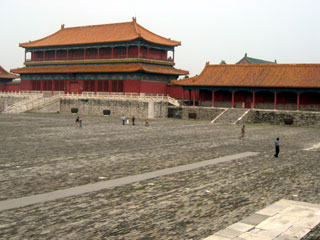
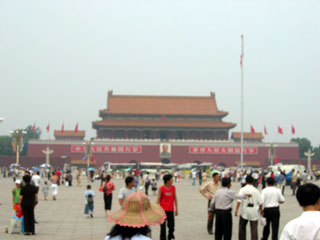
Before entering the the Forbidden City, we passed through Tiananmen Square. During his reign as Communist party leader, Mao inspected processions of up to a million soldiers here. It's a huge place, and was full of hawkers selling cold water, poloroid photos and people flying kites.
We also booked a trek along the Great Wall of China from Jinshanling to Simatai. Despite the fact that the trek was only (!) 10km along the Great Wall on China, it took us 4.5 hours. The wall follows the highest point of the surrounding landscape, and at points was almost insanely steep! The views were amazing. Some of the way the wall had been restored, but there were several areas which hadn't and the wall had crumbled away.
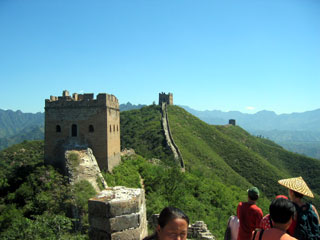
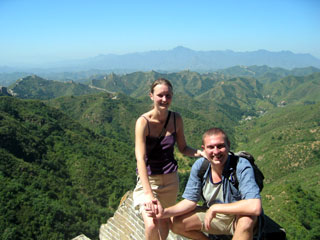
Occasionally we would encounter some locals, selling water and postcards and t-shirts. They walked along with us. At one point we had to climb 103 steps to reach the next tower. The locals shot up the stairs and helped pull us up at the top, leaving the 5 of us clambering up at a steady pace. The old lady Katie was talking to said she was 70 years old. She was amazingly nimble, running up the wall and jumping over the ruins.
After 4.5 hours we reached Simatai, where there was a zipline down or another 1/2 hour walk to reach the bottom, we were so tired we opted for the zipline down through the gorge. We slept very well that night.
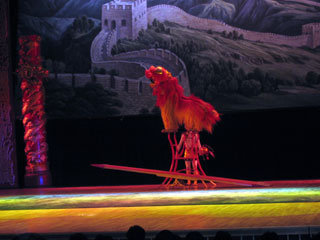
One evening we went to see the acrobatics. The stunts they were able to perform were amazing. The dancing dragons and the acrobatics were particularly impressive.
On our last weekend there was a concert inside the Worker's Stadium by a Chinese pop star, called Wang Fay. We got to hear it for free. It was really good. The Chinese went mad for her. By the time we left Beijing we were really ready to get out into the countryside and out of the smog.
On our last day in Beijing we visited The Summer Palace where the Emperor used to spend the summer, away from the blistering heat of the Forbidden City. It was huge. We got lost in the grounds several times. The views from the top on the Palace over the huge lake were amazing.

We left Beijing by train and headed for Pingyao. We originally planned to spend a couple of days there and then continue to Chengdu.
